Insulation

Insulation
Installing insulation into cavity walls, floors, roofs and floors, where there previously was none (or where the insulation is very old) is a practical way to make your home more comfortable and energy efficient, with less heat being able to escape.
Loft Insulation
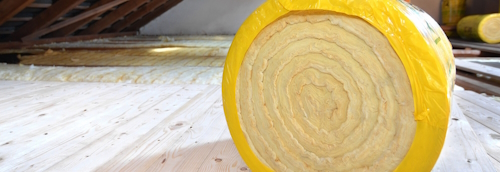
Loft insulation is one of the cheapest and easiest types of insulation to check and upgrade.
The recommended thickness of loft insulation is about 12” or more. If you have less than 8” it is recommended that you increase this.
The standard material to use is Rockwool, which can be bought at many DIY or hardware stores. This is a fibre spun from molten rock materials that are a byproduct of the steel industry. It can either be bought loose, or enclosed in plastic casing to make it more pleasant to work with.
Some points worth noting:
Cold Water Tanks – A gap in the insulation should be left under any cold-water tanks in the loft. The tank should then be insulated on top and round the sides (e.g. with a suitable jacket), continuing down to the level of the joists. Also any pipes in the loft should be fitted with tightly fitting pre-formed lagging or similar to prevent them freezing. Pipe frost protection equipment is now also available if you have pipes which are prone to freezing.
Loft Hatches – Even if you have a well-insulated loft, if your loft hatch is not properly sealed with draught‑proofing, heat will be wasted. The hatch lid should also be insulated.
Recessed Ceiling Lights should be boxed in with fire-proof materials and insulated over, with a vent on top. See www.thermahooddirect.com
Sloping Ceilings
Many sloping ceilings are not insulated even if the loft is insulated where the ceiling level. Sloping ceilings occur where the room extends a bit into the roof space so that some of the ceiling in the room follows the slope of the roof.
It is usually almost impossible for insulation to be slid down between the ceiling and the roof covering from above, The only way of insulating sloping ceilings is to fix insulation material to the sloping ceiling from below.
The Normal practice would be to use a technique similar to applying internal insulation to a wall, I.e. to fix insulation bats to the surface, and finish with plaster. Care must be taken to know whether to use breathable or non-breathable materials, and whether to use a vapour barrier.
Useful additional advice can be found on the Historic England website here.
Cavity Wall Insulation
If you have cavity walls, you may be able to get these insulated.
Most houses built of brick between 1930 and the present are likely to be cavity brick (two skins of brick with a cavity usually of about 2” between them). Brick houses before 1910 were almost always solid brick i.e. two brick thickness, but with no cavity. Between these dates it could be either.
Building regulations were upgraded in 1976 to start to impose minimum insulation levels in domestic homes, so from about this date, walls started to incorporate isulation. If your house was built before 1976 it is unlikely to have had insulation built in at the time of construction. Many houses have since then had insulation added retrospectively. This is a relatively easy job to do. (building standards have been revised many times since to gradually increase the requirement for energy efficiency).
The installer will drill holes in the mortar joints every 2m or so over the wall area, and inject insulation into the cavity. When they are finished they would fill the holes, and they are usually fairly good at matching the colour of fill to the mortar colour, but it is usually possible by careful inspection to detect these filled holes if the wall has had insulation added retrospectively.
If you are unsure (e.g. the build date is in the 1970s) an installer can drill a hole and inspect the cavity with a borescope, and can check if the cavity is filled or not. If they are called upon to do a fill, they will normally check with a borescope anyway to make sure that the cavity is suitable for filling as there are some occasions when it is not sensible (e.g. if the cavity has too much mortar filling it)
If the house has penetrating damp, or is in a location that is very exposed to driving rain, it might be advisable not to fill the cavity, but if this is not the case, cavity insulation is recommended for any unfilled cavities.
Solid Wall Insulation
Houses built before 1910, if stone or brick, are likely to have solid walls i.e. no cavity. If this is the case, the only option to improve the insulation is to add insulation either externally or internally (External Wall Insulation (EWI) or Internal Wall Insulation (IWI).
Technically EWI is a better solution than IWI, because the heavy masonry is inside the insulation which acts as a heat store, keeping the internal temperature more stable, and also because it is easier to avoid leaving cold bridges (e.g. between floors). However, often EWI is not appropriate, because of the house being in a conservation zone, or other technical reasons such as insufficient overhangs on the roof to protect the upper edges of the insulation.
Both techniques require careful design and planning and installation to ensure that you do not create problems such as condensation behind insulation, or growth of mould. They can be done by a competent amateur, but only if proper technical advice is sought and followed. Otherwise engage the services of an experienced professional.
Heritage England have good information documents describing the techniques that can be used: https://historicengland.org.uk/images-books/publications/eehb-insulating-solid-walls/
Another good source of advice is the website of Ty Mawr, see https://view.publitas.com/p222-14383/retrofit-booklet-v2022-89okaeydebek/page/1
Underfloor Insulation
Ideally all houses should have insulated floors, however this is quite an expensive and disruptive process. Best tackled when other refurbishment is being carried out. You can find more details here: https://historicengland.org.uk/advice/technical-advice/energy-efficiency-and-historic-buildings/insulating-floors-in-historic-buildings/